There is a lot of noise about AI agents. Much of it focuses on what they might do. Very little explains why most implementations fail in production.
This article is about that second problem.
The gap between demos and reality
If you have used AI in recent years, you have probably seen strong demos: drafting email, summarizing documents, answering product questions. Useful — but in the way a search engine is useful. You go to it, ask, then act on the answer yourself.
An agent is different. An agent acts. It does not wait to be asked. It takes a task, works through it, uses tools, decides, and escalates to a person when judgment is required. The difference sounds small; the organizational impact is not.
Building something that actually behaves this way — reliably, safely, within the boundaries your enterprise requires — is much harder than a demo suggests.
How Copyl approaches the problem
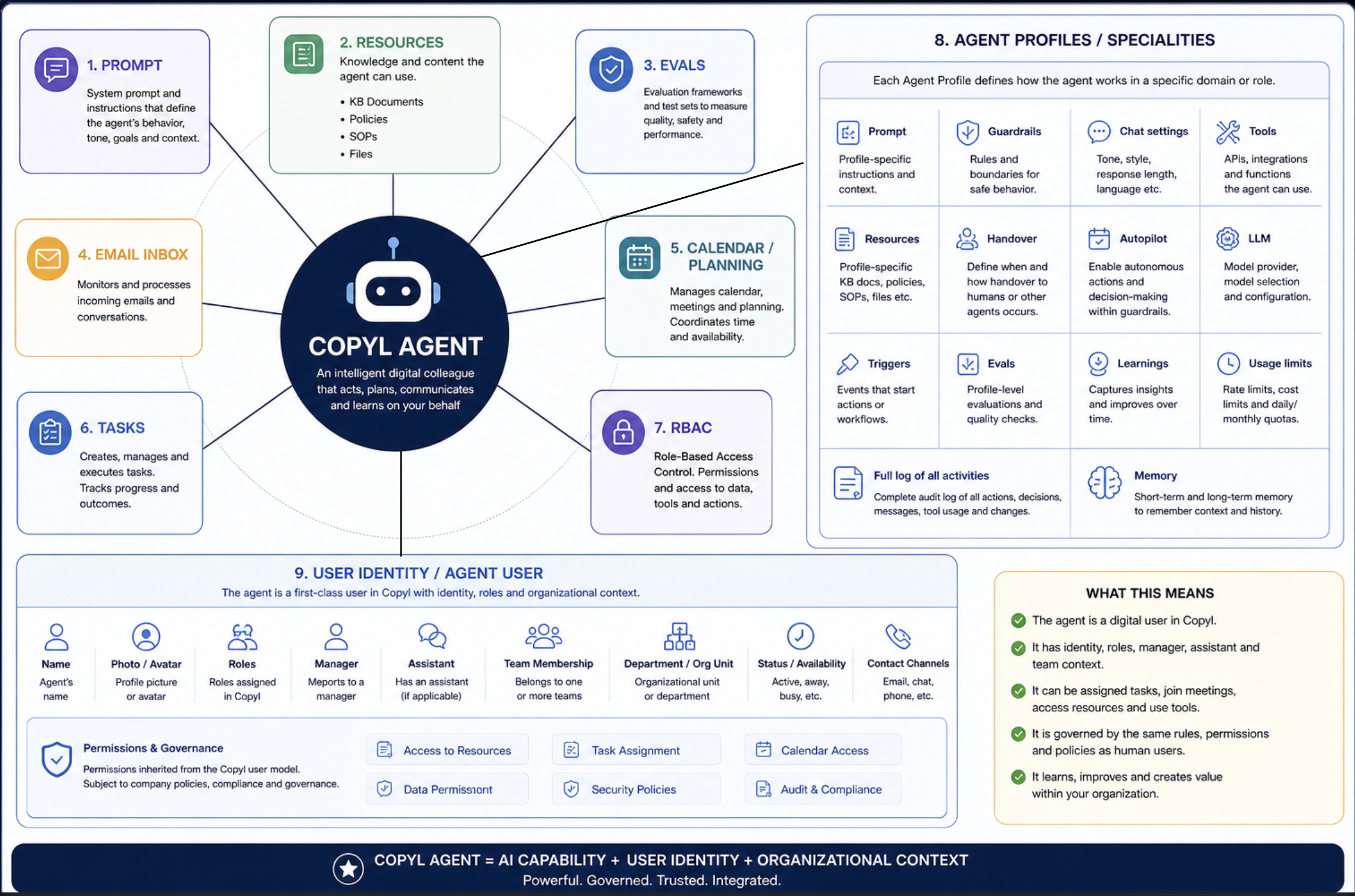
Copyl agents are built on a simple idea: an AI agent is only as capable as the context it runs in. Give it the right information, tools, constraints, and organizational identity, and it becomes operationally useful. Remove any of that and you get a lab success that fails in the real world.
The architecture reflects it. Every Copyl agent is assembled from connected parts — not a feature list, but a system where each layer supports the rest.
Prompt and behavior. A system prompt defines how the agent reasons, communicates, and prioritizes. It is not a generic template: it encodes your operating context and role so every decision stays aligned with how your organization works.
Resources. The agent must know your facts. In Copyl, that means your policies, standard operating procedures, knowledge base articles, and internal files — not the open web by default, but the knowledge that actually governs your work.
Task execution. This is where work becomes real. Copyl agents can create, run, and track tasks — progress and outcomes, not only suggested next steps. The gap between an agent that tells you what to do and one that does the work is the point of the product.
Email and calendar. The agent lives in the channels where work happens. It can monitor inboxes, handle incoming requests, manage scheduling, and coordinate people and systems — within the parameters you define.
Governance. Role-based access means the agent only touches data and actions you authorize. For serious enterprise use, that is not optional. The agent follows the same permissions, data policies, and compliance expectations as your people.
Evaluation. Most programs skip ongoing quality control. Copyl includes evaluation so you can measure accuracy, safety, and performance over time. You need a clear answer to: how do we know it is working? This is that answer.
Agent profiles: specialization without sprawl
Most organizations do not need one generalist. They need customer support, sales, and internal operations to behave differently. Building three separate stacks to do that is expensive and hard to own.
Agent profiles in Copyl are role-specific layers on the base agent. Each profile has its own prompt, resources, tools, guardrails, and handover rules for human escalation.
Profiles also set autonomy: some flows run end-to-end inside guardrails; others require human sign-off at defined points. You configure that per profile, so different parts of the business can use different risk-appropriate levels of AI autonomy.
Every action is logged — decisions, messages, tool use, and changes. That supports compliance and trust: you can inspect what happened and why.
What many platforms miss: identity
Copyl treats the agent as a first-class user: a named participant with a role, manager, teams, department, and contact channels — visible in the organizational structure like a new colleague.
That is not cosmetic. It is what makes integration work. With a real identity, the agent can receive assignments like any member, access only what the role allows, join workflows that expect named participants, and sit inside the same audit and compliance frameworks as people.
Copyl sums it as: AI capability + user identity + organizational context. Remove one, and you have a prototype, not a production system.
Why this matters for enterprise adoption
Rollouts often stall not because models are weak, but because the solution does not match how the company runs: weak governance hooks, no fit with identity and access, strong on clean inputs and brittle when reality is messy.
Copyl agents are aimed at environments where data boundaries, access control, and traceability are mandatory — where an AI acting for the organization must be explainable and auditable.
That is not a side feature. It is the design center.
To learn how Copyl agents can be configured for your organization, visit copyl.com.