Tools like Claude, ChatGPT, and Copilot Studio make it easy to build a single AI agent. But running five, ten, or fifty agents across your company is a completely different problem — one that requires an operating system, not another chatbot.
The five things a decision-maker needs to know
If you only read one section, read this.
-
No vendor lock-in. Copyl is LLM-agnostic. Your agents can use OpenAI, Anthropic, Google, Mistral, or open-source models — and switch between them without rebuilding anything. You own the decision of which AI to use, always.
-
Your data stays in the EU. Copyl can run entirely within the EU, so your data never crosses jurisdictional borders. For companies subject to GDPR, DORA, or sector-specific regulation, this isn’t a feature — it’s a requirement.
-
Full governance and audit trail. Every agent action is logged, traceable, and auditable. Role-based access control goes all the way down to individual API endpoints — not just who can use an agent, but exactly what each agent is allowed to do in every connected system.
-
Agents that actually work together. Copyl agents share context, trigger each other, and coordinate across tasks. Each agent has its own email address and calendar, making them first-class participants in your organization’s workflows — not isolated browser tabs.
-
Enterprise guardrails. Set organization-wide rules that override everything else. Example: no agent may send an email to anyone outside the organization without human approval. These rules are enforced at the platform level, not hoped for at the prompt level.
Building agents is solved. Managing them is not.
Let’s be clear: Claude is an extraordinary tool. So is ChatGPT. If your goal is to create a single agent that summarizes reports or analyzes data, you don’t need us. Those tools are fantastic at what they do.
But the moment your company has multiple agents doing real work, you face questions that no individual AI tool is designed to answer — questions about access, compliance, coordination, and control.
That gap between “we have AI agents” and “we manage AI agents” is exactly where Copyl sits.
What makes Copyl fundamentally different
LLM-agnostic by design — because no single model is best at everything
Here’s something most teams learn too late: different LLMs are better at different things. One model excels at reasoning over financial data. Another is faster and cheaper for simple classification. A third handles multilingual content better than the rest. When you lock all your agents to a single provider, you’re overpaying for simple tasks and underperforming on complex ones — at the same time.
Most AI agent tools force exactly this trade-off. Build in ChatGPT, and everything runs on OpenAI. Build in Claude, and everything runs on Anthropic. You inherit one provider’s pricing, rate limits, context windows, and blind spots — for every task, regardless of fit.
Copyl agents use intelligent model routing: a classifier evaluates each task and automatically selects the right model for the job. A lightweight model handles simple tasks at a fraction of the cost. A powerful model kicks in for complex reasoning. You get better results and lower costs without managing it yourself — and you’re never locked in. Models improve at different rates and pricing shifts constantly. With Copyl, switching is a configuration change, not a rebuild. And if you want to bring your own API keys on the Enterprise tier, you can.
Connect to any API and any database
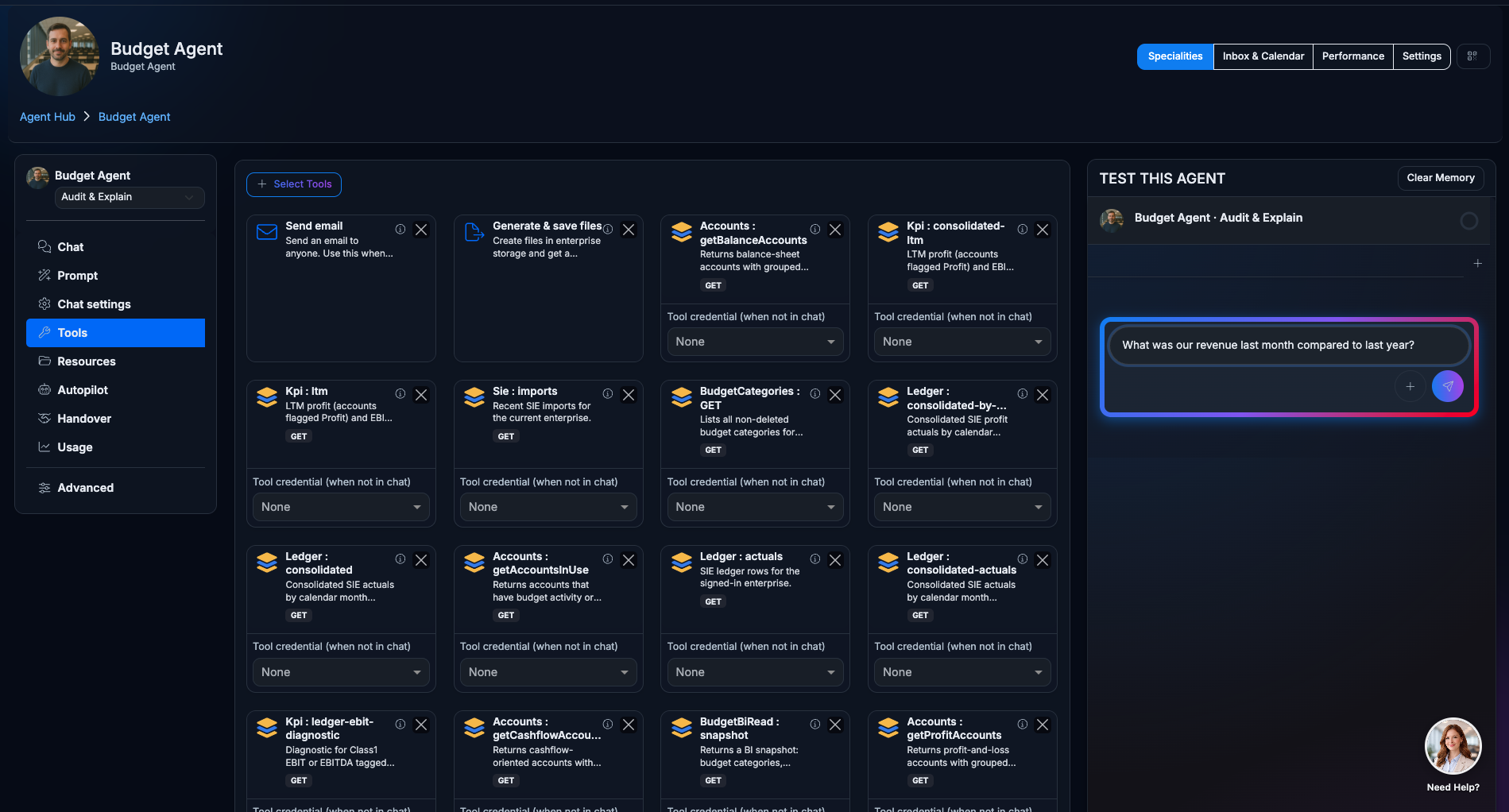
Copyl agents aren’t limited to MCP connectors or pre-built integrations. They connect to any REST API and any database — your ERP, CRM, data warehouse, or proprietary internal systems.
The critical difference: you can set role-based access control on every individual action and endpoint in a connected API. Your finance agent can read from your accounting system but not write. Your HR agent can update employee records but not access salary data. This is granular, per-endpoint governance — not broad on/off permissions.
Agent profiles — specialists, not generalists
A Copyl agent doesn’t try to do everything in a single prompt. Each agent has one or more agent profiles — specialized configurations with their own rules, prompts, and instructions. A customer service agent might have separate profiles for complaint handling, order tracking, and escalation, each optimized for how it works, what it delivers, and what it costs.
This architecture means better output quality, lower token costs, and predictable behavior — because each profile is scoped to do one thing well.
Enterprise guardrails
Platform-level rules that apply to every agent, no exceptions. These aren’t suggestions in a system prompt — they’re enforced constraints.
Examples:
- No agent may email anyone outside the organization without human handover
- All agents must log data source references for every output
- Agents accessing financial data must use EU-hosted models only
- No agent may delete records in any connected system
Guardrails are set once by IT or compliance and enforced everywhere. Individual teams can’t override them, and neither can the agents.
Every agent is a real participant
Each Copyl agent has its own email address and calendar. That means agents can receive tasks via email, schedule follow-ups, send meeting invites, and be booked like any other team member. They don’t live inside a chat window — they live inside your organization’s existing workflows.
EU data residency
For companies in regulated industries — finance, insurance, healthcare, public sector — data sovereignty isn’t optional. Copyl offers full EU data residency: your agents, their data, and their logs can all remain within European infrastructure. No data crosses to US servers unless you explicitly choose it.
Side by side
| Capability | DIY agents (Claude, ChatGPT, etc.) | Copyl |
|---|---|---|
| Build a single agent | Easy and fast | Yes — with governance from day one |
| LLM flexibility | Locked to one provider | LLM-agnostic, intelligent model routing |
| Data residency | Depends on provider | Full EU option available |
| Agent-to-agent communication | Manual / custom code | Built-in, automatic |
| API & database connectivity | Limited to pre-built integrations | Any REST API, any database |
| Access control | Not available | RBAC per agent, per user, per API endpoint |
| Agent profiles / specializations | One prompt does everything | Multiple profiles per agent, each optimized |
| Enterprise guardrails | Hoped for in prompts | Enforced at platform level |
| Audit trail | Conversation logs at best | Complete, compliance-ready |
| Regulatory compliance (DORA, GDPR) | Your problem entirely | Built into the platform |
| Cost tracking | Estimate from API bills | Granular, per agent and task |
| Agent email & calendar | Not available | Each agent has its own |
| IT governance | Shadow AI risk | Full IT visibility and control |
Who needs Copyl — and who doesn’t
If you’re a solo analyst using Claude to help you write memos, keep doing exactly that. Claude is great, and you don’t need a platform.
But if you’re a CIO, CISO, or head of operations at a company with 200+ employees — and AI agents are starting to appear across departments, some sanctioned, some not — you have a governance gap that widens every week.
Copyl doesn’t replace your AI tools. It gives you the layer of control, compliance, and orchestration on top of them. Think of it as the difference between employees using random apps on personal laptops versus a managed IT environment. Both get work done. Only one is sustainable.
The bottom line
The question isn’t whether to use AI agents — that’s already settled. The question is whether to manage them like infrastructure or hope for the best.
Every other technology your company relies on has governance, access control, and audit trails. AI agents should be no different.
Ready to go from agents to an AI operation? See how Copyl gives you governance, orchestration, and compliance for every AI agent in your organization.